The AI toolset most teams are using today wasn’t planned. It grew one tool at a time. Teams are standardizing on different coding agents while individual engineers continue running their favorite coding agents. Who enforces company rules about code, costs, and approved models?
All these little decisions create unforeseen consequences for teams coding with AI tools. There are the real tool costs, but there are also hidden costs related to missing security reviews, no record of what tools were used, a lack of repeatable model and harness benchmarks, missing team usage patterns, and no open-weight model comparisons.
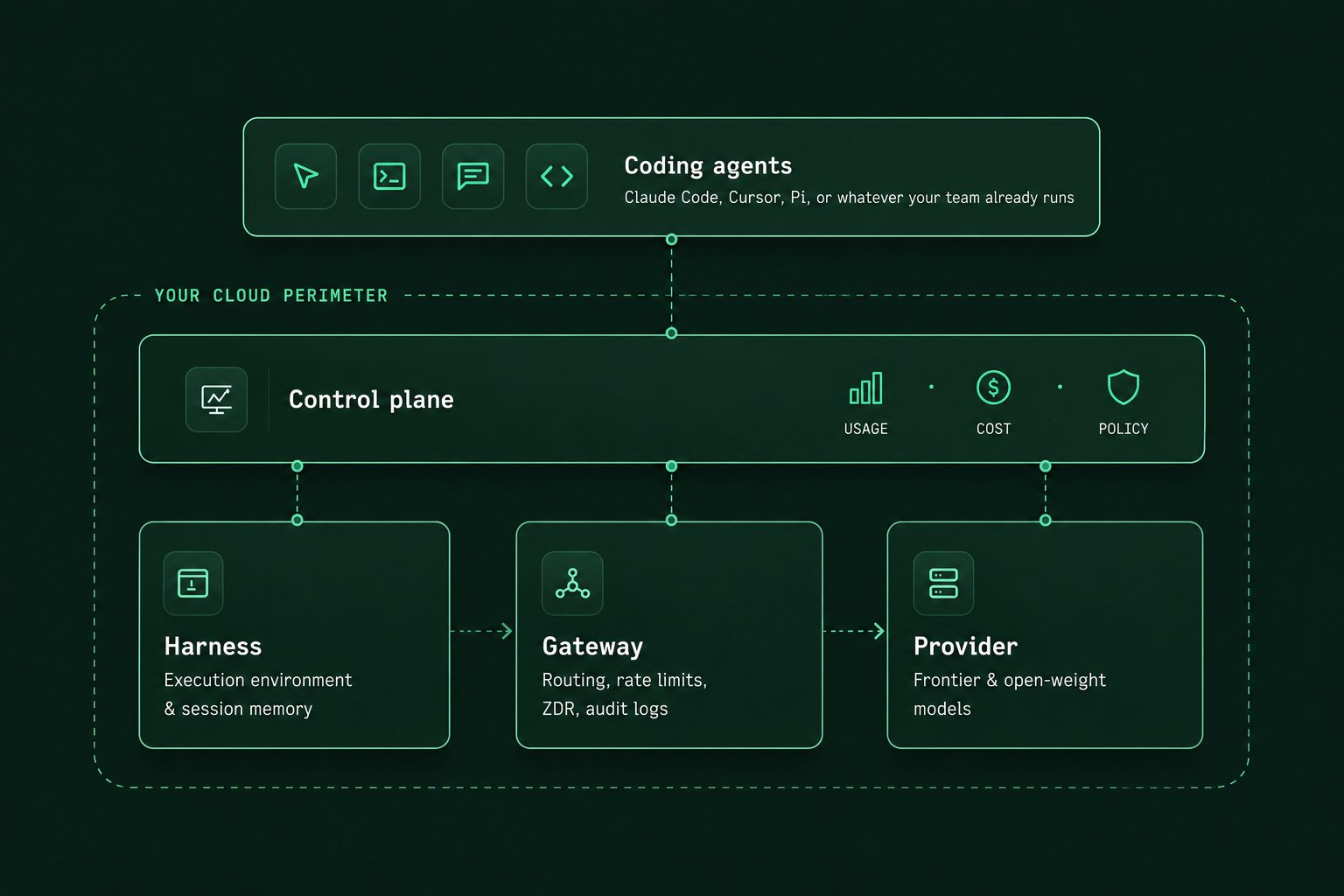
mo connects your engineers to every approved model at your company, frontier and open-weight, through a single gateway and execution harness. It speeds developer work, cuts spend with automated task-to-model routing, and gives leadership one control plane for usage, cost, and policy.
This post is organized by role, so you can jump to the part that you’re most interested in or explore a different perspective.
Jump to: platform teams · engineering leads · leadership teamsPlatform teams: a single layer you own
Every team that allows more than a single coding tool has the same challenge eventually: nobody owns the layer in between the coding agent and provider. Teams frequently pick their own provider, set their own budgets, decide their own policies, and the platform team ends up managing a patchwork they didn’t design and don’t have visibility into.
mo’s gateway is the missing layer, built to be owned rather than just installed. The platform team can manage this layer at whatever level of detail they want, from individual model calls to aggregate spend. Every tool and every user routes through a single gateway, giving the platform team a single point of control they can tune and manage.
The gateway handles the operational work directly: rate limiting, per-key route restrictions, role-based access control, budget ceilings with hard stops, and metering that rolls every request up by user, team, org, and project. Keys can be minted, scoped to specific model routes, and revoked in seconds, with no redeploy required. Automated task-to-model routing also lives at this layer, ensuring that the models work on appropriate tasks. For platform teams, this provides a policy lever they can configure.
This layer enforces Zero Data Retention (ZDR) on every call. The gateway keeps no prompt, code, or reply content, but rather a detailed, tamper-evident metadata-only usage record: tokens, cost, timing, identity. Headers reach a provider only from a fixed allow-list, and the credential a developer holds is a short-lived, vended token that expires within the hour and gets re-vended, never extended. Provider keys remain in the gateway itself.
An unreachable key store causes the gateway to reject requests instead of letting them through unchecked, and because keys are re-read on every request, revoking access takes effect immediately.
There are many individual solutions that can be put together to cover the complete workflow. Platform teams often find that some teams are already running unapproved tools across it. mo offers a supported, pre-built solution that is fully governed, with evaluation built in rather than left to a separate process. New models go through structured investigation, validation, and benchmarking before they’re approved for production use, so a platform team has evidence based on their code examples rather than vendor claims.
Request a workload audit: send us a few of your team’s real repos, and we’ll walk through the benchmark data, cost comparison, and gateway config before you commit to anything.
mo’s enablement program runs embedded engagements: benchmark evals on your own workloads, head-to-head provider bake-offs, and self-hosting on your own hardware when desired. Everything is handed off as infrastructure your team owns afterward.
Engineering leads: increase speed, without changing how your team already codes
As an engineering leader, the first question you will ask about mo is whether this replaces what your team already uses for coding. It doesn’t. mo runs the harness your team already has.
mo works with coding agents like Claude Code and Pi. Your team keeps the same habits and shortcuts, but underneath those tools you get model choice, token counts, and ZDR. This is all handled uniformly across the team by mo, rather than left to each developer to make their own choices.
mo also comes with its own harness, which, when compared with Claude Code, ran twice as fast and was 4x less expensive, with no measurable difference in output quality. Same task, same prompt, same test gates compared side by side.
Beyond the harness, mo can also handle task-to-model selection automatically, using the same routing engine platform teams configure and tune, based on benchmarked results using your code. Routine work goes to a fast, inexpensive model. Complicated reasoning gets directed to a frontier model. This routing, or phase shift, happens without a developer having to choose a model by hand for every task.
This creates increased team velocity and automatically embeds frugality: faster loops, less waiting on a slow or overburdened backend, and a manager-level view of your team’s prompts and sessions that can be reused instead of relearning what works best every time.
Session sharing further enables the spread of knowledge. It allows a developer to grant access for a live session to a teammate, time-limited by default and easily revoked. Because credentials never leave the gateway, sharing a session isn’t the same as sharing access.
Getting started doesn’t require a migration. Install mo, point it at the harness your team already runs, and the rest happens behind the scenes.
Leadership teams: evaluate models before you commit and track team spend
For executive readers, the model layer is where most of the financial exposure lives, and it is seldom visible across individuals and teams. mo makes all usage visible and accountable while operating under ZDR policies.
mo hosts or serves models inside the corporate VPC or through Momento’s infrastructure, keeping every route under ZDR policies. Frontier models and open-weight models sit behind the same gateway, so switching between them is a routing decision rather than a migration.
Tracking the cost of work is enabled through the control plane. This matters for both top-down use and multi-tenant use, when developers and product managers share the same systems. Being able to assign costs and usage enables proper budgeting and accurate feature-cost calculations.
With custom benchmarks, new models are continuously tested based on the team’s use cases and criteria rather than relying on compromised external benchmarks. The data covers speed, cost, and accuracy results that can be used to guide the team’s usage.
As of July 2026, using real tasks scored by a multi-model judge panel, an open-weight model (GLM-5.2) came in at roughly 0.4 times the metered cost of Claude Opus 4.8, while scoring within a tenth of a point on a 0 to 5 quality scale—4.2 versus 4.3—with both passing all six automated test suites. That’s the gap mo is built to capture automatically, on the tasks that matter, with real numbers rather than opinions.
Security within AI workflows is still evolving, so it’s important to ground the conversation in how data is handled, what is retained, and how keys are minted, scoped, and revoked. With mo, existing agreements pass through unchanged; mo adds metering and harness guardrails around them without renegotiating anything. Offboarding takes effect immediately, since access rides on revocable keys that are re-read on every request.
The velocity engineering leads get and the ownership platform teams get both roll up into this same view: one place to see what’s running, what it costs, and whether it’s approved.
Next step: request the 1-pager and set up a short call to walk through deployment options.
One control plane, three roles
Platform teams, engineering leads, and executives are looking at the same system through different windows, and usage, cost, and policy still roll up to the same place no matter which window you started from.
An engineering lead who installs mo for faster agent loops is, without extra setup, already inside a system a platform team can govern and a security team can audit. mo doesn’t ask any one team to adopt the whole story before getting value from the piece of it that’s most important to them.
Put mo to work on your models.
Install it. Talk to us about enablement. Let’s discuss how to get you started with customized model benchmarks and automated task-to-model routing, all with centralized control and compliance guardrails.