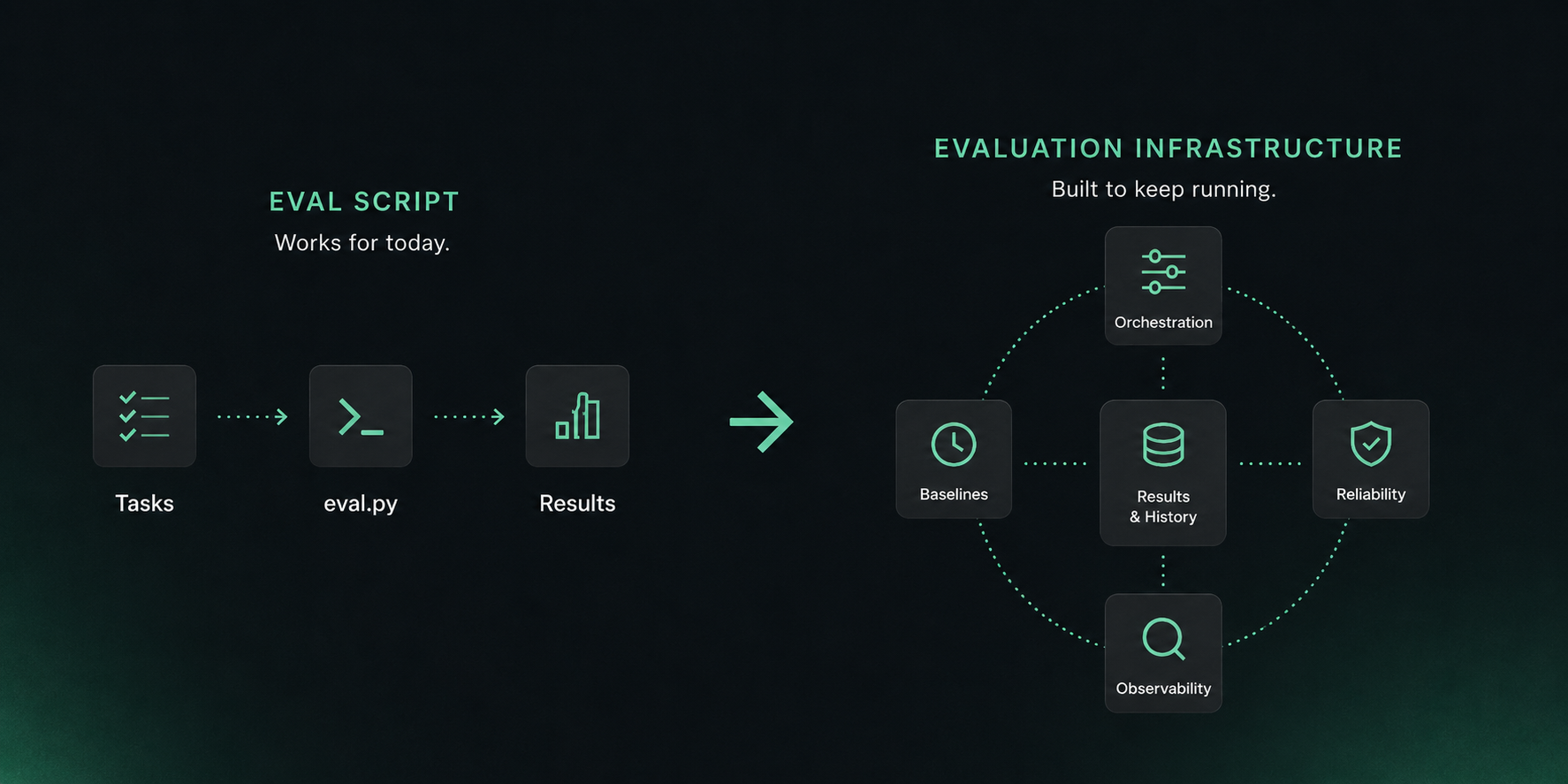
One of the main differences between building a quick prototype to help make your AI toolchain decisions and a dedicated product like mo eval is the infrastructure backing them. Creating a prototype is trivial to build with a handful of plain text prompts. It’s fast and easy, and that makes it dangerous. The gap between the quick prototype and a system that is designed and developed for a task is enormous, but the cracks aren’t visible until you try to use it as a robust system.
One-off and ongoing have different requirements
A quick script is well suited to an immediate evaluation need. However, serving as the long-term backbone of toolchain design and decisions is a different job entirely.
Owning a script that gets rerun and manually patched every time something changes in the toolchain is not only a hassle but also a liability to the team and business. Evaluation systems need supported code, defined processes, and the ability to survive the person who wrote the script moving on to other projects.
The test runs, when done with statistical relevance in mind, can be expensive and time-consuming to produce. The finished results should be part of a permanent performance record. The value goes beyond the single run and is seen in the historical trends and ability to query the results months later, without spending tokens or time to do so. Otherwise, you pay the full price of the analysis every time a question comes up.
The scale gets big and reliability must be managed
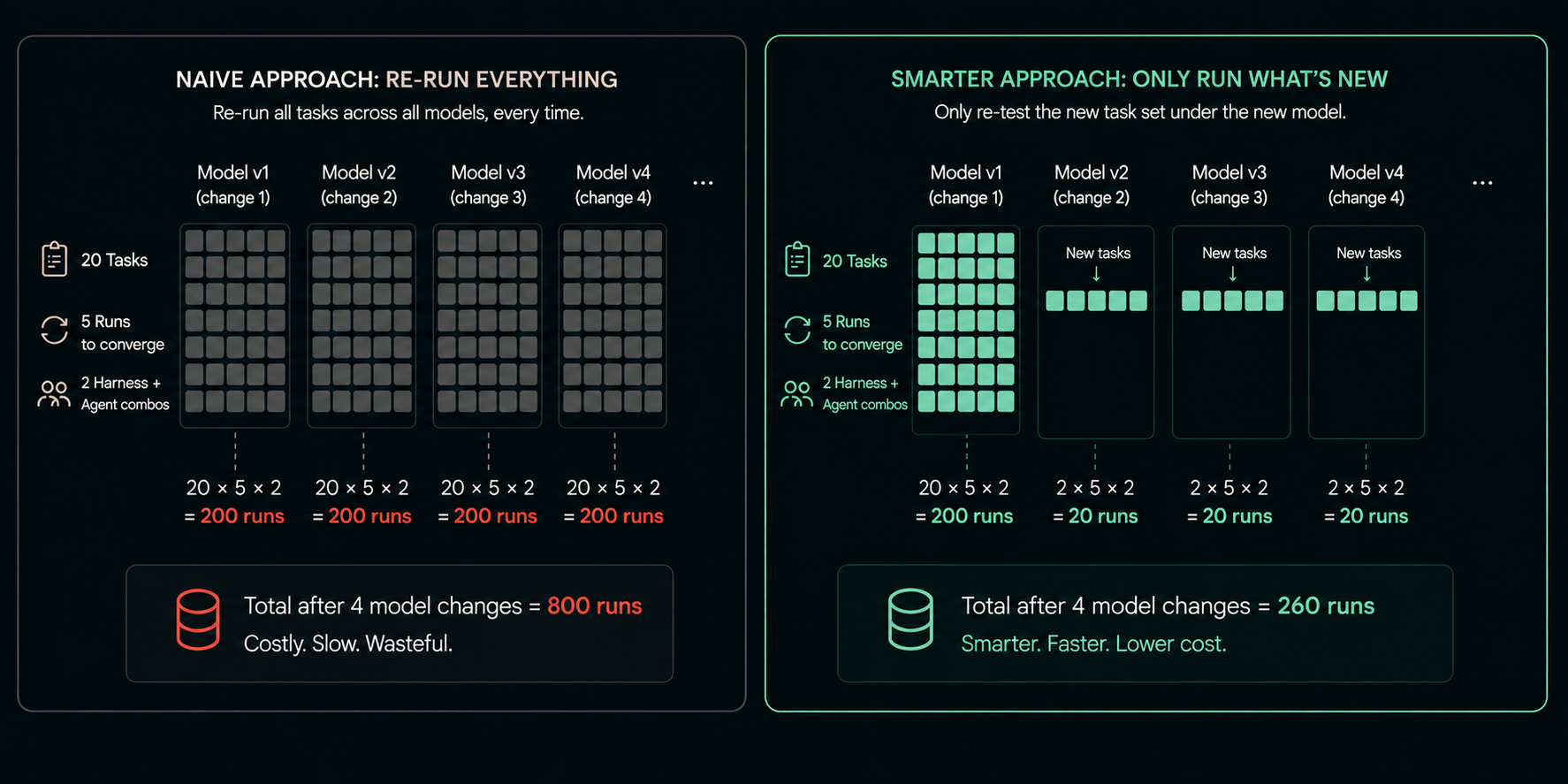
New versions of the tools in your toolchain, especially models, are shipping constantly, and this is where the evaluation system must grow quickly. If your evaluation system checks 20 coding tasks for each model change and requires 5 runs to converge on an answer, this requires 100 individual runs. If you have to support the model change and test it against two combinations of harness and coding agent, it becomes 200 runs. When part of the new toolchain changes or new tasks are added, more tests need to be run, but mo eval only re-tests the new task set under the new model. A naive implementation requires re-running every test in every case, increasing cost and wasting time. mo also saves the previous test results, which act as the historical baseline the changes are measured against.
Depending on the complexity of the task, runs can take minutes or even hours. The evaluation system must have a plan for prompts failing, token throttling, and mid-run crashes. With every part of the toolchain out of the evaluation system's direct control, reliability becomes a requirement.
Logs and traces tell the story
Isolating what went wrong only works if the system collects enough information both as logs and traces, and as tool behavior. Understanding the failure conditions requires a historical look back coupled with root-cause analysis. With a quick script build, the failures are going to be silent with lengthy debugging times. With a managed solution, retries and failure analysis are built in.
mo eval is that dedicated evaluation infrastructure where runs are preserved and reusable, queries and analysis are separate from eval runs, and the system is designed to keep running as new models and tools are shipped.
Each change in your AI toolchain is a bet. Determining whether it’s an improvement or degradation is a science all its own. Rigorously driving evaluations continuously at organization scale is an infrastructure commitment many teams don’t realize they have taken on until the ship has already sailed. That’s the case for treating AI toolchain evaluation as a system to be built and maintained instead of a script written quickly and updated continuously.
Explore the series:
AI toolchain evaluation isn’t just about running tests. It’s about producing results you can trust and building the infrastructure to keep producing them.
Part 1: Verifying AI toolchain updates is hard
Why every toolchain change needs evidence that it improved things without introducing regressions.
Part 2: Comparing AI toolchains is easy, but can you trust the results?
Why trustworthy comparisons require repeatability, independent judgement, and statistical rigor.